
2026-08-27 · Season 0 · Ep. 3
Why UpKorean lives on the web
How the name came from UpEnglish without being the same company, why we bought upkorean.com without drama, why we skip the app stores for now — and two Korean web words: 홈피 and 공홈.
This is Season 0, Episode 3 of building UpKorean in public.
Episode 1 was the bottleneck (particles, politeness, speaking). Episode 2 was “why another product?” This one is smaller and more practical:
Why this name, why this domain, and why we’re shipping as a website / PWA — not as a default App Store or Google Play app.
The name — UpKorean
I looked at more than one name. The one that stuck was UpKorean.
It came from association with UpEnglish — an English-learning / academy-side system already in my world. That does not mean the two products are the same company story, or that Korean learners need to care about that link. It only means English education was already sitting on my desk. Once you’re thinking about how people learn a language with real speaking pressure, Korean education stops feeling like a random side quest. It feels like the next honest question.
So the brand is a naming rhyme, not a claim that “if you know one, you know the other.”
The domain — upkorean.com
No treasure-hunt story here.
I sized the market I wanted to serve, wrote down the plan, and bought the domain. That’s it. upkorean.com was the URL I wanted learners and search engines to remember. Buying it early was hygiene, not a plot twist.
Mailbox stuff (hello@…) is the same category: ops convenience, not a brand myth. I’m skipping the Gabia forwarding saga on purpose.
홈피 (hompi) and 공홈 (gonghom)
A short Korea-side dictionary beat — nothing exotic. Most Koreans already know these.
홈피 (hompi) is old everyday slang for a homepage: home + page, squashed the way Hangul loves to squash. Before every product shouted “download the 어플 (eopeul),” the normal way to meet a brand online was still “go to their 홈피 (hompi).”
공홈 (gonghom) is shorter and still current: 공식 홈페이지 (gongsik hompeiji) — the official homepage. When someone asks for the real site (not a random mirror, not only a store card), people say “공홈 (gonghom) 주소 있어 (juso isseo)?” (gonghom juso isseo?) — roughly “got the official-home URL?”
I’m not claiming the app-store era never happened. I’m saying the language never fully deleted the idea that a product has a real address. For UpKorean, that address is the point: upkorean.com is the 공홈 (gonghom). The installable PWA is optional sugar on top — closer to a home-screen 어플 (eopeul) icon without making the store the default door.
Why web / PWA — not “apps are bad”
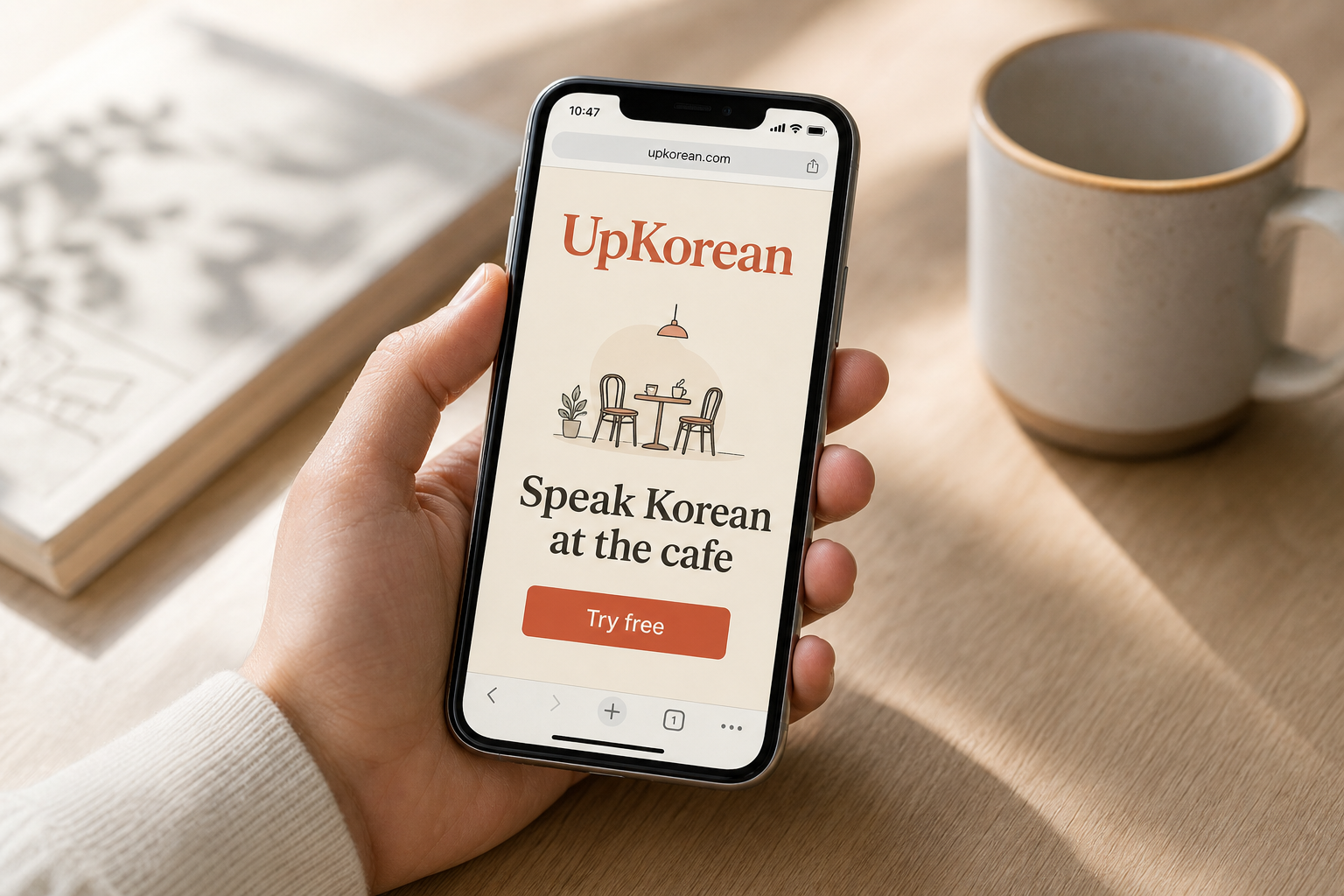
Korean speakers often call a phone app an 어플 (eopeul) — short for application. A site is a 사이트 (saiteu). A PWA sits in the blur: you open it in the browser, and on many phones you can add it to the 홈 화면 (hom hwamyeon) — the home screen — without waiting on a store listing.
I’m not writing this episode to dunk on Apple or Google. Stores are useful for a lot of products. My design bet for UpKorean is narrower.
Store fees are real. When distribution takes a cut — the famous ~30% band people quote for in-app purchases — that cost doesn’t vanish. It becomes cost pressure. Some of it ends up in the learner’s price. If I want the product to stay as cheap as I can honestly make it, selling on the open web (with a merchant-of-record that fits overseas learners) is the cleaner path for this product.
What I didn’t optimize for: review queues, rejection anxiety, store SEO. I’ve used enough systems as a builder to believe a mobile-first website + installable PWA is already enough for a speaking loop on a phone. I’ve tried the Add-to-Home path myself. It felt good. It felt sufficient.
So the line is not “native apps are obsolete.” The line is:
For UpKorean’s MVP — and as the default strategy later — we stay on the web / PWA. If learners later shout loudly for a store listing, we can reconsider. We are not pretending the demand already exists just so we can look bigger.
That matches how I try to work in general. I’m not the founder who pours capital into marketing to invent urgency. I build when the need is real. Trademark filings, store wrappers, louder ads — those wait on situation, not on a vanity checklist. (This is not legal advice; it’s a build preference.)
What this means for you as a learner
You don’t need to install anything from a store to try Hangul + cafe speaking on upkorean.com. Open the 공홈 (gonghom). If your browser offers Add to Home Screen, that’s the PWA path — closer to an 어플 (eopeul) icon without the store tax baked into our default plan.
Catalog is still early. Soft invite only. If the hole from Episodes 1–2 matches what you felt, the site is there.
Next episode
Season 0 · Ep. 4 — Drawing the IP line — why we don’t use K-pop lyrics or drama clips as lesson bait.
Disclosure
Build log, not a store review. Fee math is a design bet about learner price, not a claim that we “beat” native apps. PWA behavior differs by phone/browser (especially iOS). Name link to UpEnglish is associative, not a shared-product promise. 홈피 (hompi) / 공홈 (gonghom) are common Korean web slang, not a lesson drill. Screens and catalog change as we ship. I’m Korean; my English is good enough to ship, not native-perfect — if a line is unfair or too sure, tell us.
Series: Building UpKorean (Season 0 — origin).
- learn Korean
- UpKorean
- progressive web app
- PWA
- web app
- App Store
- Google Play
- 어플 (eopeul)
- 홈피 (hompi)
- 공홈 (gonghom)
- 홈 화면 (hom hwamyeon)
- 사이트 (saiteu)
- building in public
- indie founder