
2026-09-05 · Season 0 · Ep. 5
Past 작심삼일 — ninety days of speaking, not fluency
Why UpKorean bets on ~90 days at ~10 minutes a day: confidence before CEFR, escaping New Year’s three-day resolve, and a Shinjuku kiosk memory about how fast Korea moved.
This is Season 0, Episode 5 of building UpKorean in public.
Episode 1 was the learner bottleneck. Episode 2 was the product gap. Episode 3 was web / PWA. Episode 4 was the IP line. This one is the time promise on the landing page:
About ninety days. About ten minutes of new practice a day. Travel-ready speaking — not “fluency.”
I’m not selling a miracle. I’m explaining why we wrote that sentence — and what I hope changes first if someone actually sticks with it.
작심삼일 (jaksimsamil) — three days of resolve
Korean has a phrase for a plan that fades almost immediately: 작심삼일 (jaksimsamil) — roughly “decide in the heart for three days.”
New Year is the classic stage. People announce they will quit smoking, wake up early, or finally study. Many of those announcements last about three days.
Korean study often follows the same pattern. A burst of apps, a weekend of notes, then silence.
So when I say ninety days, I’m not trying to sound like a university syllabus. I’m naming a stretch long enough to get past 작심삼일 (jaksimsamnil) — roughly a season where speaking Korean can become a habit, not a New Year announcement.
Three months is still short against a lifetime of fluency. It is long against a three-day spike.
What I want after ninety days (order matters)
Here is the odd part: Korean ability is not first.
In real communication, the first thing that often breaks is confidence. Without it, words you “know” do not come out. Easy lines freeze when a person looks up.
So if someone walks an honest ninety-day path with us, I hope the wins land in this order:
- Confidence — you can open your mouth without disappearing.
- Achievement — you finished something real; the path was finite and visible.
- Korean speaking skill — survival lines, particles under pressure, politeness that doesn’t panic you.
I’m saying we design the product for mouth + mood, not only for a CEFR badge.
What “travel-ready” can mean
Concrete, not mystical:
- Order at a counter with 해요체 (haeyoche) lines like
커피 한 잔 주세요(keopi han jan juseyo). - Handle short shop / station / hotel exchanges without melting.
- Hear the difference between 반말 (banmal), 해요체 (haeyoche), and 합니다체 (hamnidache) — and not treat “longer ending = more respectful” as a rule of nature.
- Keep speaking with review and saved clips after the beginner course ends.
What it should not mean
- Drama without subtitles.
- Smooth free talk with strangers on day ninety.
- Workplace honorifics as a finished system.
- “I’m fluent now.”
If we ever write copy that sounds like fluency in a season, that copy is wrong. Episode 1 already named the walls. Ninety days is a wedge, not the whole mountain.
Why about ten minutes (desk + judgment)
I asked myself why not start “hard” — thirty, sixty, two hours. The honest answer: a hard start usually fails faster. That is 작심삼일 (jaksimsamnil) with a stopwatch.
UpKorean’s base clock is about ten minutes of new practice a day, with a soft ceiling near thirty minutes before pure drill gets boring. That is founder judgment shaped by using drill apps myself — even half an hour of this genre can feel long.
Desk research does not hand us a sacred “exactly 12 minutes” law. It does point in a friendly direction:
| Signal | What it suggests | How sure |
|---|---|---|
| Spacing effect | Spreading practice across days beats cramming the same total minutes into one heroic weekend (classic memory research; reviews of spaced practice). | Strong direction |
| Category sessions | Mass-market language apps often land around ~8–12 minutes per active day in public session numbers (desk aggregates — not our users yet). | Medium |
| Product design | Apps like Babbel openly market ~10–15 minute lessons as a daily shape. | Design target |
| Habit research | Automaticity often takes weeks of repeats, not three heroic days (widely cited habit studies — averages, not destiny). | Soft cite |
So ~10–15 minutes is a practical way past 작심삼일 (jaksimsamnil): small enough to repeat, large enough to include listen → pattern → speak. Frequency matters more than pretending you will study like a school subject after work.
We still want depth in the catalog. Short days only work if the path is honest about how many days of new material exist — which is why we talk about ninety days instead of “infinite Korean.”
Aside: Shinjuku ticket machines, then Korea’s kiosk wave
About fifteen years ago I was in Tokyo. In a Shinjuku back-street ramen shop, one person seemed to run everything — kitchen and counter. The seating felt built for 혼밥 (honbap) — eating alone, one-person spots. At the entrance: a ticket / order machine. Pay first, hand the ticket, eat.
I remember thinking: Korea will get this soon.
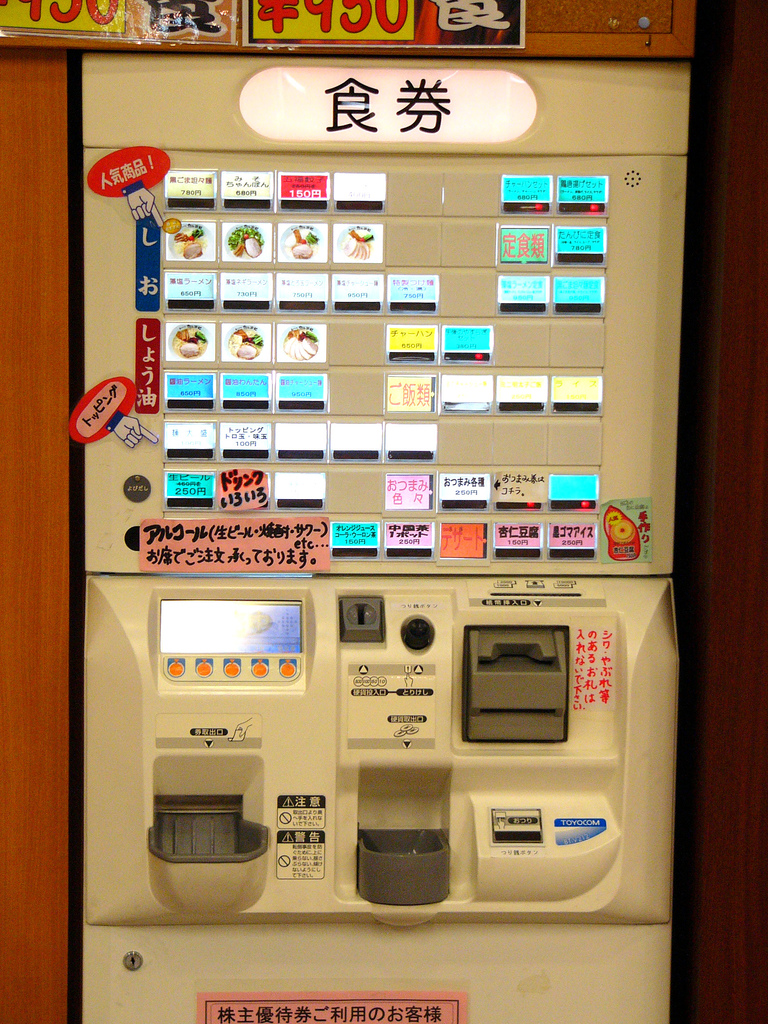
Years in Canada later, I came back. It was already everywhere — cafes, fast food, stations, rest stops. Labor cost is the obvious driver. Whether that is “good” or “cold” depends on the day and the shop. What struck me was speed: when Korea decides something is useful, it can move in one direction, very fast. Some people insult that as herd behavior. From what I’ve seen, it can also be a kind of strength — for better and worse.
Payment is part of that picture. Desk check (2020s): many older Japanese ramen 食券 (shokken) machines are still cash-first, while newer ones add cards, transit IC, or QR. In Korea, Bank of Korea survey data put cash near ~16% of payment occasions in 2024 (about ~41% in 2013), with more card-only kiosks. China often leads further on mobile wallets at the till. Same “order machine” idea; different money habits.
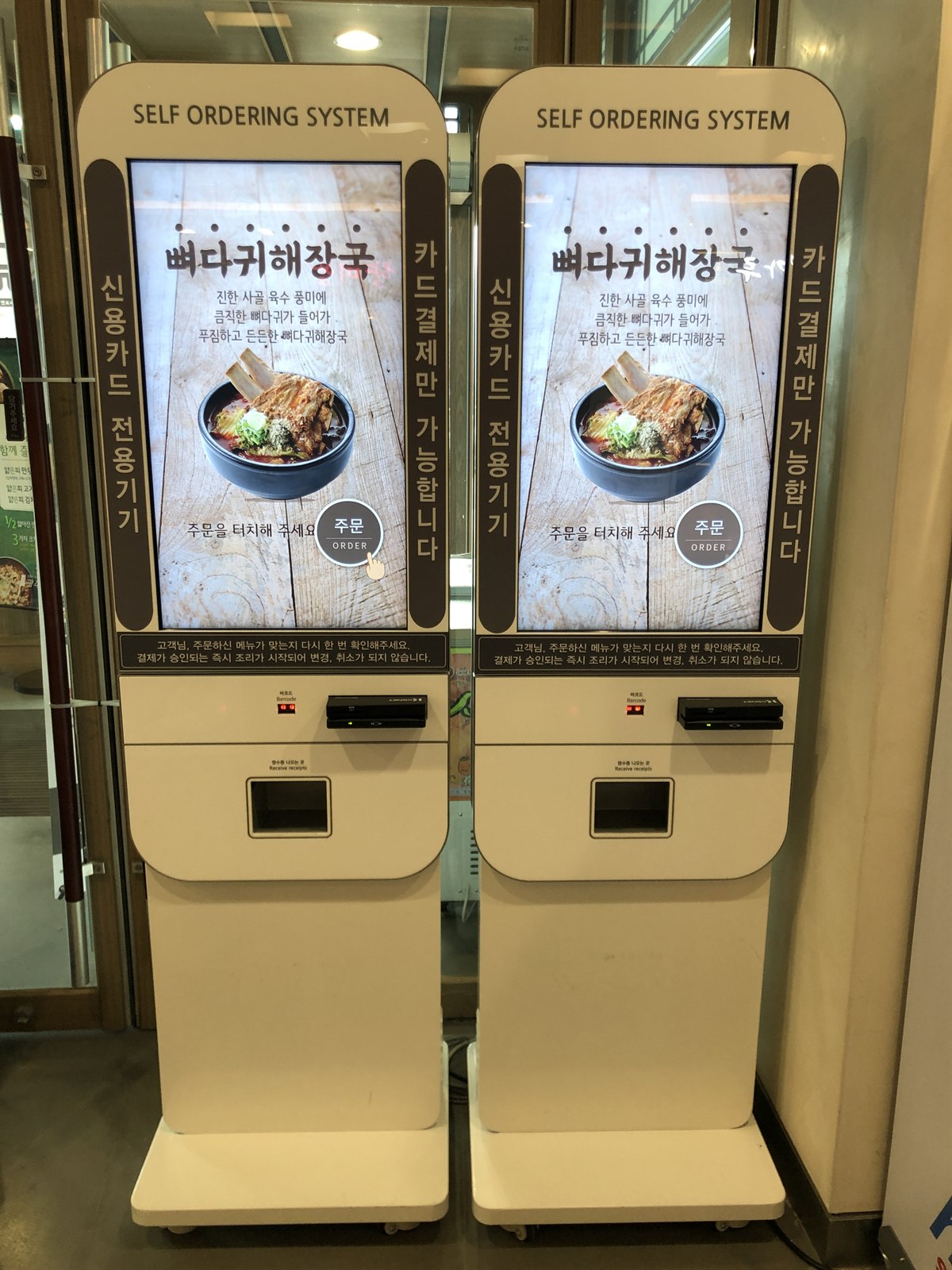
I like the small mismatch in that still: 뼈다귀해장국 (ppyeodagwi-haejangguk) — hangover soup with bones — sold through a sleek card-only self-order screen. Not a temple or an alley stall. Just an old dish on a new machine.
For learners, the product lesson is not “never talk to humans.” Kiosks change the default. Staff lines become shorter and more precious. Hangul on a screen becomes literacy. And when you do speak, survival 해요체 (haeyoche) still matters — which is why we keep teaching …주세요 (juseyo) as living customer speech, not as a museum sentence.
The design bet (again)
Ninety days is our finite speaking wedge:
- particles and politeness in the loop,
- microphone every lesson,
- about ten minutes of new work a day,
- confidence and a finished-path feeling ahead of a fluency fantasy.
If that sounds small, good. Small is how you get past three days.
Hangul + the first cafe scenario stay free to try on upkorean.com. Soft invite only — I’m still building in public.
Next
Season 0 closes the “why this system” arc. Season 1 starts the spine: lessons as data, not hardcoded screens — and the listen → slot → speak wheel in more detail.
- learn Korean
- Korean speaking practice
- 작심삼일 (jaksimsamnil)
- 90 day Korean
- travel Korean
- 해요체 (haeyoche)
- Korean kiosk
- 키오스크 (kioseukeu)
- building in public
- UpKorean
- language learning habit